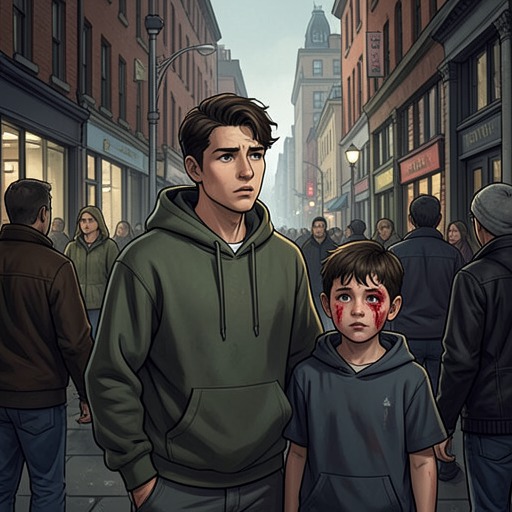
Djamel
Sonne und BetonDjamel is introduced through a confrontation in which insults, posturing, and the pressure of an audience rapidly become physical violence. His first defining encounter with Lukas establishes him as a source of danger and gives their conflict a personal history that Lukas does not initially know.
First Encounter and Assault
At first, Lukas knows Djamel only as the young man who confronts the group. After Julius tries to refuse an offer and makes a racist remark, Lukas pulls him away; Djamel reacts by challenging Lukas and shoving him. Djamel’s friends close around them in a semicircle. Lukas apologizes and tries to leave, but Djamel insults him for being German, mocks his stammer, and threatens to hit him. Lukas forces himself to meet Djamel’s gaze, believing that looking down would make him seem vulnerable.
Julius then reveals that he and Djamel knew each other from elementary school, naming their former teacher as he tries to appeal to their shared past. Lukas is surprised: Julius had not mentioned the connection before the confrontation. Djamel dismisses Julius and keeps his attention on Lukas, pressing his forehead against Lukas’s and demanding to know why Lukas pulled his friend away. The recognition offers no way out; instead, Djamel continues to challenge him in front of the group.
When Lukas’s attention follows Djamel’s spit to the ground, Djamel punches him in the cheekbone. One of the others kicks Lukas in the stomach while another films him on a phone; Gino and Julius remain frozen nearby. Djamel orders Lukas to look at him and fight, then punches him in the nose and solar plexus. Lukas’s nose bleeds, his vision blurs, and he struggles to breathe. Before grabbing Lukas’s face, Djamel wipes the blood from his fist onto Lukas’s T-shirt. The assault makes humiliation part of the violence: Lukas is not only hurt, but watched and recorded as Djamel asserts control over the encounter.
The Park Confrontation and Reversal
Later, Lukas returns to the park with Cem, Gino, and Julius. At the bench where the earlier assault took place, at least ten people are gathered, laughing at something on a phone; Lukas suspects they are watching the video of his beating. One of them whistles at the approaching group, drawing residents to their windows, while Djamel’s companions begin moving toward them. Lukas carries a Telescopic Baton and tries to steel himself to strike, but when Djamel steps out of the crowd and challenges him, Lukas cannot move. The baton slips from his hand. His paralysis sharply recalls the earlier encounter, when Djamel’s audience and direct stare had helped turn Lukas’s fear of appearing weak into part of the violence.
The confrontation shifts when Djamel insults Cem and invokes his association with Germans. Cem answers without speaking, striking Djamel in the face with his left elbow; Djamel’s temple splits, and blood covers his face. He shouts a death threat, and the crowd surges toward him. Engin picks up Lukas’s fallen baton and swings blindly, while Cem’s brothers arrive and pull Djamel’s attackers away, shoving them down and kicking them. The park becomes a chaotic group fight rather than a one-sided assault. Lukas remains stunned until Gino grips his shoulder and looks at him in panic. Djamel’s violence has helped set the scene in motion, but this time the encounter does not leave Lukas alone before an audience: Cem’s intervention and the arrival of his brothers immediately widen the balance of force.
At the Bat-Yam-Platz, Lukas later sees Djamel again as people pour out of the subway station. Lukas moves closer to Marco and, with Ali, Serkan, and others around them, deliberately carries himself as though he belongs with S44. Djamel notices the group, grows visibly unsettled, lowers his eyes, then looks at Lukas once more and runs. Lukas cannot stop grinning; he takes Djamel’s retreat as proof that Djamel will never touch him again. The reversal is real in the moment, but it rests on a different kind of protection: where the first encounter left Lukas exposed before Djamel’s crowd, at the plaza he is backed by a larger group and performs the confidence that the earlier assault had stripped away.
Characterization and Narrative Perspective
Djamel is characterized almost entirely from the outside. The narration offers no account of his private thoughts or motives; instead, his changing power in the scenes is made legible through what he does in public: stepping forward, holding Lukas’s gaze, attacking, and later retreating. This limited access keeps him from becoming a fully explained antagonist. The reader encounters him as Lukas does, through immediate gestures and the threat they carry.
That external portrait also makes audience and group affiliation central to Djamel’s presence. In the first encounter, his companions close around Lukas, and the assault is watched and recorded; in the later park confrontation, the crowd gathers again, but the balance shifts when Cem intervenes and others join the fight. At Bat-Yam-Platz, Djamel’s retreat follows Lukas’s deliberate display of belonging with a larger group. These reversals do not establish a private change in Djamel; they show how the visible terms of confrontation—who stands nearby, who is watched, and who can command the space—shape his authority.
Visible Aftermath
The next day, Djamel’s assault remains visible on Lukas’s face. In class, Momo asks what happened to him; Lukas says he had trouble the day before, and when Momo asks whether it was a fight, Lukas briefly nods. The exchange gives the violence a consequence beyond the park: Lukas carries its evidence into an ordinary school conversation, where the beating can be recognized even before he explains it. His terse answer confirms the fight without naming Djamel, leaving the injury itself to connect the public humiliation of the park to the quieter aftermath.